
Updated October 2026 · By the ClaudeCV Editorial Team
Resume examples for doctors: how to write a medical CV that gets noticed.
A doctor’s resume is not just a list of degrees and job titles. It is a professional proof of clinical expertise, patient care quality, leadership, research, and trust. If your CV feels too generic, too long, or too focused on duties instead of outcomes, it can quietly weaken your chances even when your experience is strong.
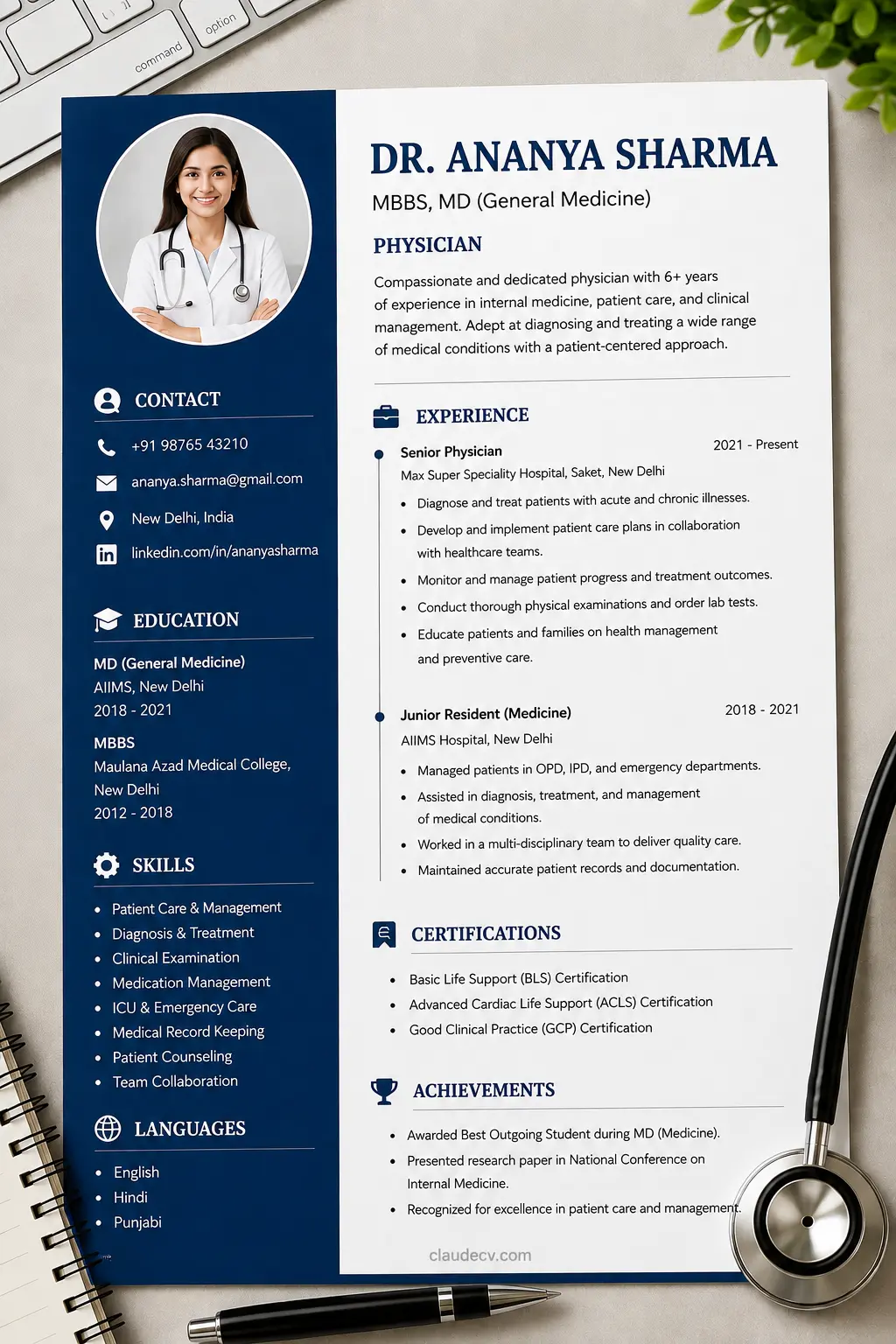
Why doctors need a stronger resume than most professionals
Doctors usually have impressive credentials, but their resumes often become overloaded with jargon, hospital names, and long duty descriptions. A recruiter or hiring manager does not need every detail of every rotation. They need a clear story: what kind of doctor you are, what you have done well, which specialties you cover, and what value you bring to a clinic, hospital, or academic role.
That is why a doctor resume should be built differently from a standard corporate resume. In medicine, credibility matters just as much as clarity. Your resume must show that you are precise, experienced, and dependable. It should also reflect your level, whether you are a fresh MBBS graduate, a resident physician, a specialist, or an experienced consultant.
What a strong doctor resume should include
For most medical professionals, the most effective resume structure looks like this:
- Professional summary — one short section that explains your specialty, years of experience, and core strengths.
- Core qualifications — degrees, internships, residency, board certifications, and medical license details.
- Clinical experience — hospital or clinic roles with responsibilities and outcomes.
- Specialty and technical skills — emergency care, pediatrics, internal medicine, surgery, diagnostics, telemedicine, ICU management, and so on.
- Research, publications, and presentations — especially important for academics or senior roles.
- Certifications and training — ACLS, BLS, neonatal resuscitation, fellowship training, and other relevant credentials.
- Leadership and teaching experience — mentoring residents, leading ward rounds, and participating in committees.
Keep the layout clean and ensure the document remains readable both on screen and when printed. Many hospitals and clinics review resumes digitally, so your resume should also be easy to parse.
How to write a resume summary for doctors
Your summary should be short and focused on your professional identity. Instead of writing a vague line like “Dedicated and hardworking doctor,” write something that gives context and direction. A strong summary might mention your specialty, your experience level, and the type of care you provide.
Example summary:
MBBS-qualified physician with three years of clinical experience in internal medicine and outpatient care. Skilled in patient assessment, treatment planning, case documentation, and collaborative hospital care. Interested in roles focusing on quality patient service and long-term care management.
This works because it is specific, credible, and easy to scan. It gives the recruiter a quick understanding of your profile without sounding exaggerated.
Resume example for a junior or early-career doctor
If you are a recent graduate, resident, or early-career physician, your resume should lead with education and training, then highlight clinical exposure and your ability to work in high-pressure situations. Your experience bullets should focus on what you handled, how you contributed, and what kind of patients or cases you supported.
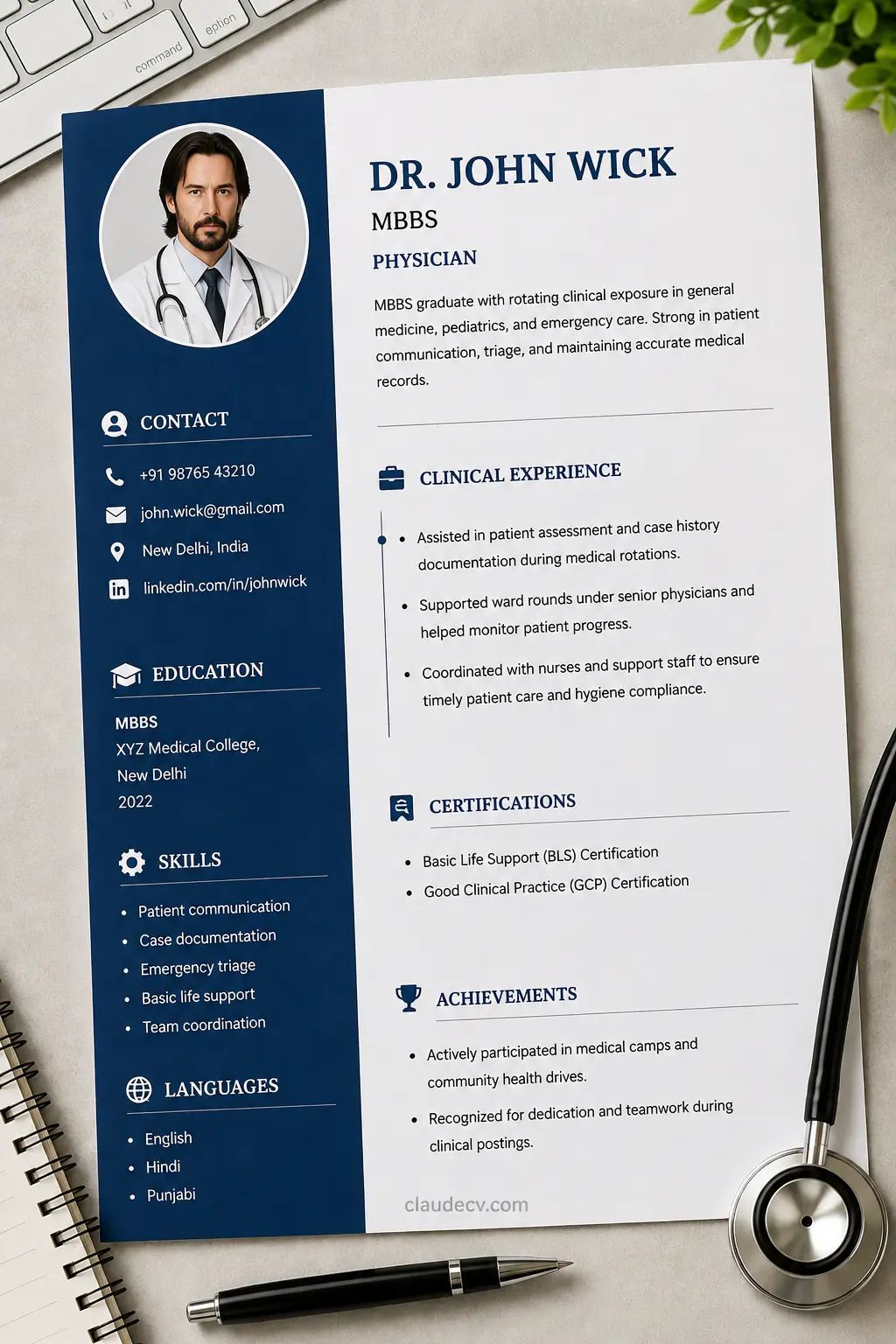
Sample structure
Name: Dr. John Wick
Summary: MBBS graduate with rotating clinical exposure in general medicine, pediatrics, and emergency care. Strong in patient communication, triage, and maintaining accurate medical records.
Education: MBBS, XYZ Medical College, 2022
Clinical Experience:
- Assisted in patient assessment and case history documentation during medical rotations.
- Supported ward rounds under senior physicians and helped monitor patient progress.
- Coordinated with nurses and support staff to ensure timely patient care and hygiene compliance.
Skills: Patient communication, case documentation, emergency triage, basic life support, team coordination
This kind of resume works because it is honest and structured. You do not need to invent advanced responsibilities. You simply need to describe your clinical exposure clearly and link it to communication, teamwork, and patient care.
Resume example for an experienced doctor or specialist
If you are a specialist, consultant, or senior physician, your resume should emphasise depth, leadership, and measurable impact. Employers want to see that you have not only treated patients but also improved systems, supported teams, handled complex cases, and contributed to the institution’s reputation.
Use bullets that describe results rather than only duties. Instead of writing “Responsible for managing patients,” use language such as “Managed high-volume outpatient clinic with consistent patient satisfaction and reduced wait times through improved workflow coordination.”
Sample experience section
Senior Resident Physician, City General Hospital
- Managed adult and pediatric cases in inpatient and outpatient settings with strong emphasis on diagnosis, treatment planning, and follow-up care.
- Coordinated daily ward rounds, supervised junior staff, and supported documentation accuracy across patient records.
- Contributed to improved discharge planning and care continuity through structured communication with nursing and administrative teams.
- Participated in clinical audits and case discussions that strengthened departmental quality and patient safety practices.
For senior doctors, publications, academic involvement, certifications, and leadership roles can become powerful differentiators. If you have presented at conferences, guided junior doctors, or contributed to research, place these in their own sections so they are easy to find.
What hiring managers look for in a medical CV
Recruiters and hospitals are usually looking for a combination of competence, professionalism, and consistency. Your resume should show that you can perform well under pressure, communicate clearly, maintain standards, and work as part of a team. The document does not need to be flashy. It needs to be trustworthy and well-organized.
A very common mistake is writing the resume as if it were a diary of every task performed in every role. That approach makes the page long and hard to read. Instead, focus on the strongest points: your specialty, your clinical experience, your training, your leadership, and your patient-care impact.
How to tailor the same resume for different medical roles
One resume can work for multiple positions, but it should not be identical for every application. A hospital job, a private clinic post, an academic institution, and a medical consultancy role each value slightly different signals. For example, a hospital recruiter may care most about inpatient experience, emergency response, and clinical discipline. A private clinic may care more about patient communication, outpatient handling, and long-term care coordination. An academic or research position will usually look for publications, teaching experience, and training contributions. A specialist role may focus on deep expertise, procedures, and case complexity.
That is why tailoring matters even if your core experience does not change. Update the summary, reorder the experience bullets, and place the most relevant keywords near the top of the document. A medical resume does not have to be rewritten from scratch each time, but it should feel relevant to the role you want.
For instance, if you are applying to a clinic, emphasize outpatient care, patient education, preventive medicine, and communication. If you are applying to a hospital, emphasize emergency care, multidisciplinary teamwork, ward management, and patient safety. If you are applying for a teaching role, make your mentorship, lectures, training sessions, and academic contributions more visible. Small, thoughtful changes make your resume much stronger without changing the truth of your background.
A simple bullet-writing formula for medical resumes
The best resume bullets are short, structured, and outcome-focused. A reliable formula is: action + context + result. In the medical field, that usually means describing the case or responsibility, the environment, and the contribution you made. Instead of writing only what your job title was, show what you handled well.
Example before and after:
- Before: Responsible for patient care and case management.
- After: Managed day-to-day patient care in a high-volume outpatient department, supporting diagnosis, treatment planning, and follow-up coordination for a steady stream of cases.
Another example:
- Before: Assisted in ward duties and documentation.
- After: Supported ward operations by maintaining accurate documentation, monitoring patient progress, and coordinating with nursing staff to ensure continuity of care.
These versions sound stronger because they show competence without sounding inflated. They also create a much clearer picture of your daily contribution. In many medical resumes, this level of clarity matters more than trying to use highly dramatic language.
What to include if you are changing roles or moving countries
If you are switching from one medical field to another, or applying in a new country, your resume should help the reader connect your past experience to the new direction. This is especially important for doctors who want to move into private practice, telemedicine, research, or a new specialization. You may have the right experience, but the resume needs to show the bridge clearly.
One helpful approach is to create a short section called “Relevant Experience” or “Clinical Focus” that highlights the work most connected to the new role. This allows you to keep the full history intact while drawing attention to what matters most. Another useful strategy is to include a brief note on your core strengths, such as emergency medicine, patient counseling, pediatrics, diagnostics, or case documentation. This helps a recruiter understand your profile quickly without needing to interpret every detail.
For international applications, make sure licensing, certifications, and training are easy to read. If you have experience in a different healthcare system, mention transferable strengths such as adherence to protocols, documentation quality, patient safety awareness, and teamwork. These points matter because they show professionalism even when the setting is different.
ATS-friendly formatting tips for doctor resumes
Even in healthcare, your resume may pass through an applicant tracking system before it reaches a recruiter. That means your formatting should remain simple and clean. Avoid tables that may break during parsing, and do not rely on graphics, icons, or elaborate columns.
- Use standard section headings such as Summary, Experience, Education, Skills, Certifications, and Publications.
- Keep the document to one or two pages depending on experience level.
- Use keywords that match the role you are applying for, such as internal medicine, pediatrics, surgery, emergency care, ICU, outpatient care, or telemedicine.
- Save the file as a PDF if the role requires a professional submission, but make sure the formatting remains intact.
Good resumes are not only attractive; they are also easy to scan. A clear structure enables both human readers and digital systems to understand your profile quickly.
Common mistakes doctors should avoid
Many doctors make the same mistakes when writing resumes:
- Using a generic summary instead of a professional profile.
- Including too much unrelated detail from medical school or early rotations.
- Writing responsibilities without outcomes or context.
- Failing to mention licenses, board certifications, or training.
- Ignoring publications, teaching, or leadership experience that could strengthen the profile.
It is better to have a concise, focused resume than a cluttered one that hides your strongest points. A strong medical resume should feel calm, confident, and professional.
How to make your medical resume stand out
If you want your resume to feel memorable, add detail that shows judgment and reliability. Mention experience with patient communication, quality care, documentation accuracy, multidisciplinary collaboration, or emergency response. If you have worked in a high-volume setting, mention that clearly. If you have improved workflows, coordinated care, or mentored juniors, include that as evidence of leadership.
For doctors aiming at private clinics, academic institutions, or international roles, tailoring the resume is especially important. A general resume can work, but a tailored one is much stronger because it reflects the language and priorities of the specific role.
Final advice before you submit
Before sending your resume, read it once as a hiring manager would. Ask yourself whether the document quickly answers three questions: What is this doctor’s specialty? What experience do they bring? Why should they be considered for this role? If the answer is clear in the first few seconds, your resume is doing its job well.
For doctors, credibility is built through clarity. A concise, well-structured resume can help you present your knowledge, training, and professional maturity in a way that feels polished and dependable.
Ready to build your CV? Create your doctor resume on ClaudeCV with a clean, professional format that is easy to edit and export.