
Updated October 2026 · By the ClaudeCV Editorial Team
Top 10 resume mistakes to avoid (and how to fix them instantly).
You have the skills, the experience, and the drive. You apply for dozens of jobs, yet the phone isn't ringing. Sound familiar? Often, the problem isn't your qualification—it's your resume. Even the most talented professionals make critical resume mistakes that cause Applicant Tracking Systems (ATS) to reject their applications automatically, or hiring managers to pass them over within seconds.
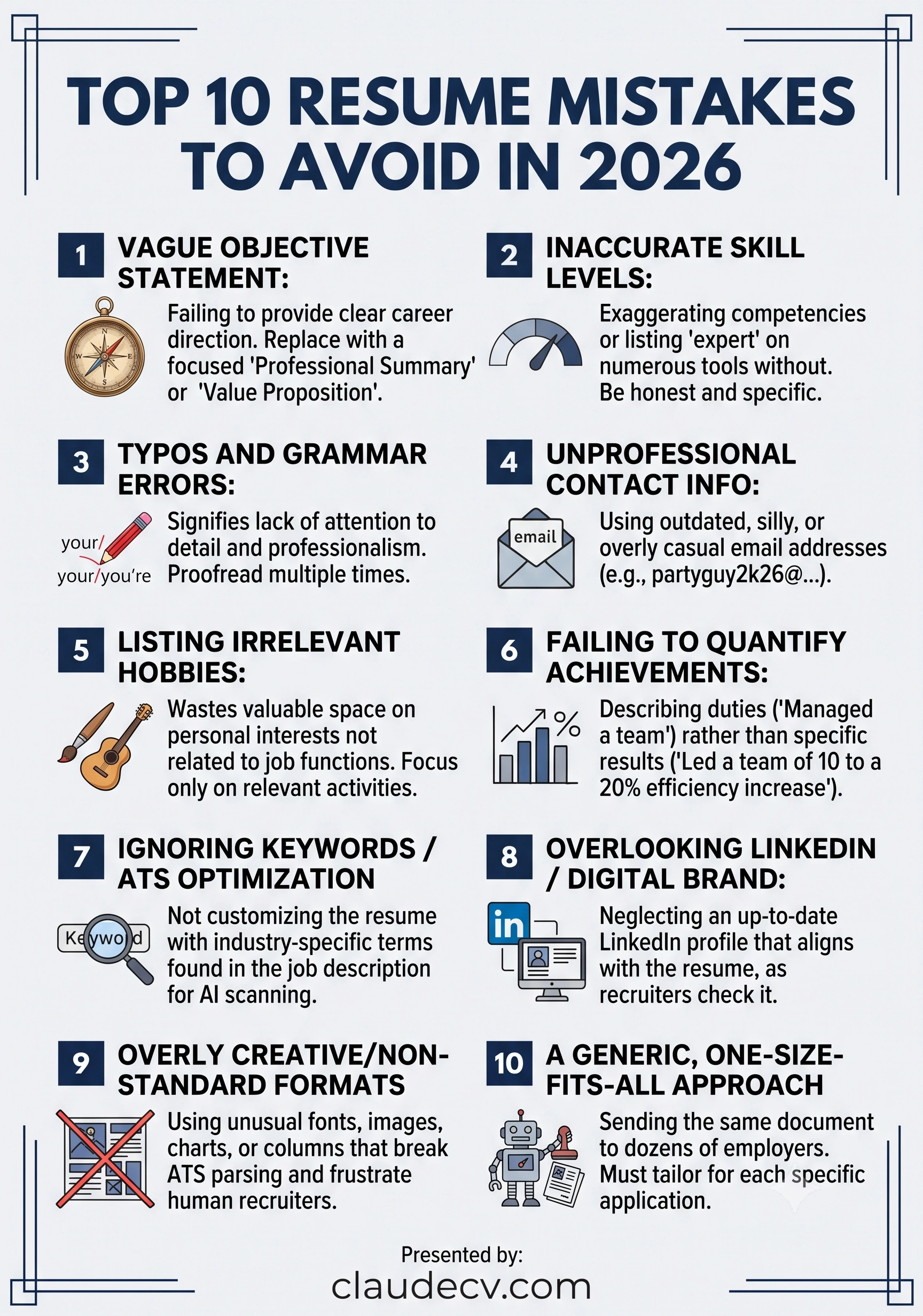
Why a flawless resume matters more than ever
In 2026, the job market is highly competitive. Recruiters receive hundreds of applications for a single corporate opening. On average, a hiring manager spends just 6 to 7 seconds scanning a resume before making a "yes" or "no" decision. If your document is cluttered, confusing, or riddled with errors, your chances drop to zero.
Furthermore, over 90% of mid-to-large companies now use Applicant Tracking Systems (ATS). If your resume format confuses the ATS bot, a human recruiter will never even see it. Let's break down the most fatal resume mistakes and exactly how to fix them to ensure you land that interview.
1. Ignoring the Applicant Tracking System (ATS)
The biggest invisible barrier between you and your dream job is the ATS. Many candidates spend hours designing beautiful, heavily stylized resumes using complex columns, graphics, charts, and unique fonts. Unfortunately, ATS bots cannot read these elements. When the system tries to parse a graphic-heavy resume, the text becomes garbled, and the software automatically rejects the application because it appears blank or incomplete.
How to fix it: Stick to standard, clean formatting. Avoid headers and footers for critical contact information. Do not use tables, text boxes, or images to convey your skills. Use standard section headings like "Experience," "Education," and "Skills" instead of creative alternatives like "My Professional Journey." Finally, always save your resume as a standard PDF or DOCX file, depending on the job posting's instructions.
2. Using one generic resume for every application
Sending the exact same resume to 50 different companies is a recipe for rejection. When a recruiter reads a generic resume, they see a candidate who wants a job, not this job. Employers want to know why you are the perfect fit for their specific role and industry.
How to fix it: Tailoring your resume does not mean rewriting it from scratch every time. Instead, adjust your Professional Summary to align with the job description. Rearrange your bullet points so the most relevant achievements are at the top. Most importantly, incorporate the exact keywords used in the job posting. If the job description asks for "Agile methodology" and "cross-functional team leadership," ensure those exact phrases appear naturally in your experience section.
3. Focusing on job duties instead of accomplishments
Your resume is not a job description; it is a marketing document. One of the most common mistakes is writing a list of duties: "Responsible for managing a team," "Handled customer complaints," or "Updated the company database." This tells the recruiter what you were supposed to do, but it doesn't tell them how well you did it.
The "Action + Context + Result" Formula
Transform your bullet points from passive duties into powerful accomplishments by adding metrics.
- Weak (Duty): Responsible for increasing sales.
- Strong (Accomplishment): Led a team of 5 sales associates to increase regional revenue by 22% ($1.2M) within 12 months by implementing a new CRM tracking system.
- Weak (Duty): Managed social media accounts.
- Strong (Accomplishment): Grew organic Instagram following from 10k to 55k in 6 months, driving a 30% increase in website traffic through targeted video campaigns.
Whenever possible, use numbers, percentages, and dollar amounts to quantify your success. Numbers stand out visually on a page and provide concrete proof of your capabilities.
4. Including an outdated "Objective Statement"
Decades ago, resumes started with an Objective Statement like: "Seeking a challenging position in a growth-oriented company where I can utilize my skills." Today, this is considered obsolete space-wasting. The recruiter already knows your objective is to get the job you applied for. Making it about what the company can do for you is the wrong approach.
How to fix it: Replace the Objective Statement with a Professional Summary. A summary is a 3-4 sentence elevator pitch highlighting your years of experience, top skills, and most notable achievements. It should focus entirely on the value you bring to the employer.
5. Poor formatting and messy design
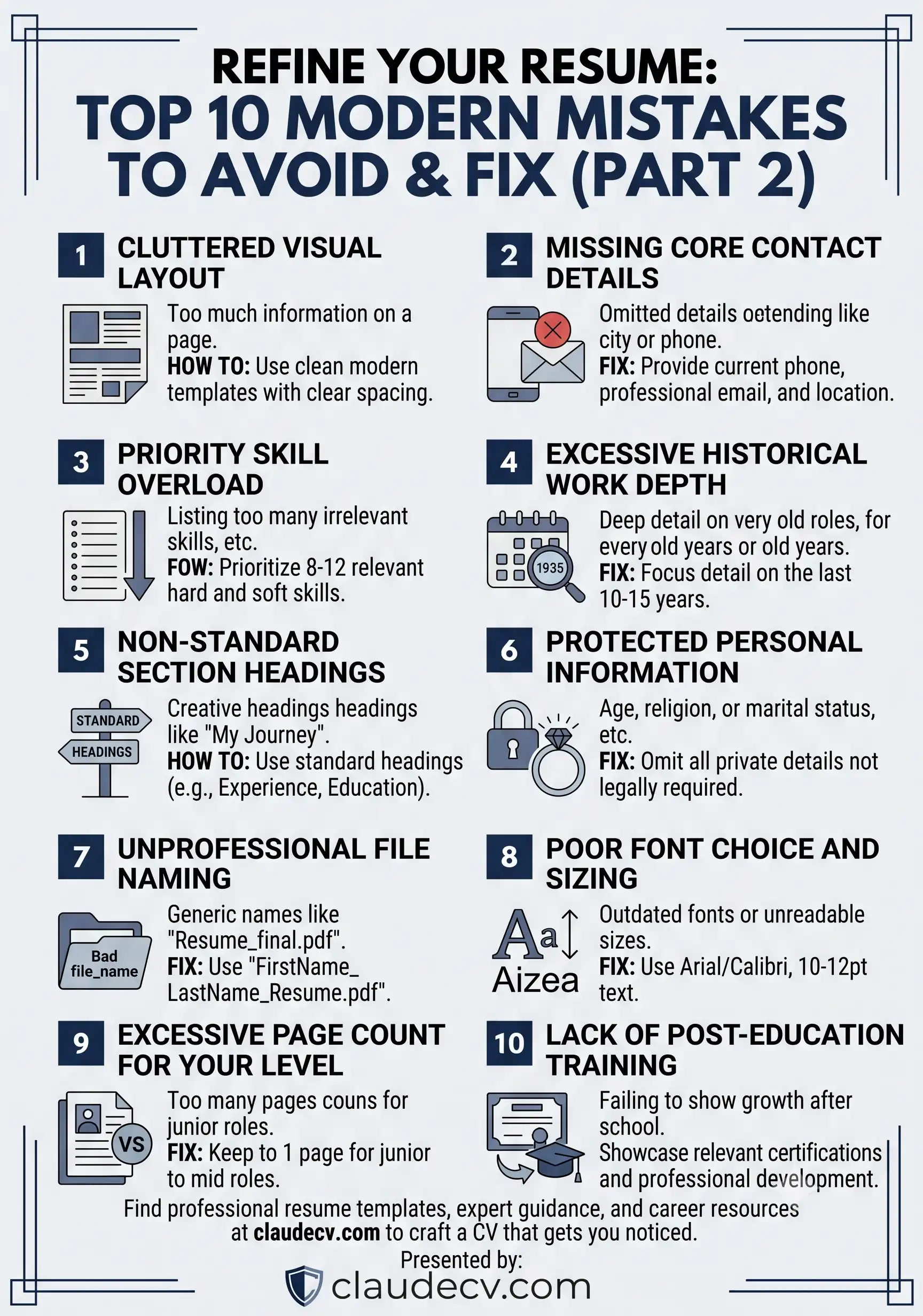
A cluttered resume is a skipped resume. Tiny margins, huge blocks of text, multiple font styles, and inconsistent bullet points make your document exhausting to read. If a recruiter has to squint or hunt for your job titles, they will move on to the next candidate.
How to fix it: Embrace whitespace. Use a standard, professional font like Arial, Calibri, Helvetica, or Roboto. Keep your font size between 10pt and 12pt for regular text, and 14pt to 16pt for headers. Set your margins to at least 0.5 to 1 inch on all sides. Use bolding and italics consistently—for example, always bold your job title and italicize the company name. Bullet points should be short and punchy, never paragraphs.
6. Spelling errors and grammatical mistakes
This seems obvious, yet it remains one of the top reasons resumes are discarded. A spelling error suggests to the employer that you lack attention to detail, rush your work, or simply don't care enough to proofread. In fields like finance, healthcare, or software development, precision is everything.
How to fix it: Do not rely solely on your word processor's spell checker; it won't catch "manager" vs "manger" or "their" vs "there". Read your resume out loud—this forces your brain to process each word individually. Better yet, run it through tools like Grammarly, and have a trusted friend or mentor review it before you submit it anywhere.
7. Making the resume too long (or unnecessarily short)
Unless you are a senior executive with 20+ years of relevant experience or applying for an academic CV role, your resume should not be three pages long. Conversely, if you have 10 years of experience, cramming it into a single page with microscopic font is a mistake.
How to fix it: The golden rule is one page for every 7-10 years of experience. If you are a recent graduate or mid-level professional, a one-page resume is ideal. If you have extensive, highly relevant experience, a two-page resume is perfectly acceptable. Cut out jobs from 15+ years ago unless they are directly relevant to the role you want now. Just list the title, company, and year without bullet points for those older roles.
8. Including irrelevant personal information
Depending on the country you are applying in, including certain personal details is not just a mistake—it can be a legal liability for the employer. Details like your age, date of birth, marital status, religion, a photograph (in countries like the US, UK, and Canada), and your full home address are unnecessary and take up valuable space.
How to fix it: Your contact header only needs four things: Your name, a professional email address, your phone number, and a link to your customized LinkedIn profile. You can include your city and state (e.g., "New York, NY" or "Remote"), but your street address is no longer required in modern recruitment.
9. Using clichés and buzzwords
Recruiters are tired of seeing the words "Go-getter," "Think outside the box," "Synergy," "Hard worker," and "Detail-oriented." These empty buzzwords take up space without providing any actual evidence of your skills. Anyone can call themselves a "hard worker," but proving it is what matters.
How to fix it: Use strong action verbs to start your bullet points. Instead of saying you are "results-driven," start your bullet with "Spearheaded," "Engineered," "Optimized," or "Transformed," followed by the actual result. Show, don't just tell. Let your achievements speak for your work ethic.
10. Unexplained employment gaps
Life happens. People get laid off, take time off to care for family, travel, or deal with health issues. However, leaving a multi-year gap on your resume without any explanation allows the hiring manager's imagination to run wild—and they usually assume the worst.
How to fix it: Be honest but strategic. If you took a year off to care for a sick relative, you can add a brief, one-line entry stating "Sabbatical / Caregiver" with the dates. If you were laid off and spent 8 months upskilling, list the courses or freelance projects you completed during that time. Showing that you remained active and engaged, even without a formal title, demonstrates resilience and continuous growth.
Final Thoughts: Your resume is a living document
Your resume is never truly "finished." It should evolve as your career grows. By eliminating these 10 common mistakes, you immediately elevate your profile above the vast majority of applicants. A clean, ATS-friendly, accomplishment-driven resume doesn't just list your past—it paves the way for your future.
Worried about making these formatting mistakes? Create your flawless, ATS-friendly resume on ClaudeCV today. Our builder automatically handles the margins, fonts, and structure so you can focus on landing the interview.